
Stoddard Juvenile Release Records
The Stoddard County Regional Juvenile Detention Center is a regional juvenile operation associated with the juvenile justice system and the 35th Judicial Circuit. Its custody decisions are not ordinary adult county-jail events. A court may direct detention, transfer, placement, return to a guardian, or another authorized outcome based on the juvenile matter.
A person who leaves this center may move to a court-approved placement or be released through an order understood by the authorized parties. Public adult terms such as a recent-release list, jail roster, or open inmate profile do not fit this facility. The controlling information belongs in the juvenile case and the authorized agency record. Those sources determine what may be disclosed and to whom.
Do not use an adult inmate search to identify a child or infer a juvenile's release. Contact the authorized juvenile case channel.
Two Stoddard Detention Facilities
The juvenile center is at 100 S. Prairie Street in Bloomfield. The Stoddard County Jail and Sheriff's Office are separately identified at 207 S. Prairie Street. Their nearby addresses can cause confusion, yet they hold different populations and operate under different legal rules.
| Facility | Role | Release information route |
|---|---|---|
| Stoddard County Regional Juvenile Detention Center | Regional juvenile detention tied to juvenile court | Authorized juvenile court and facility channels |
| Stoddard County Jail | Adult county jail operated by the Sheriff | County release record and Sheriff inquiry |
An adult booking belongs with the Sheriff even if a municipal police department made the arrest. A juvenile placement should not be redirected into that adult record path. Confirm which facility and which legal system controls the case before making any request.
Missouri Juvenile Record Limits
RSMo 211.151 addresses juvenile detention and limits routine detention of a child in an adult jail while a matter is pending. The statute supports the central distinction: juvenile detention is not simply an adult jail with younger occupants. Its court authority, placement process, and confidentiality framework differ.
Juvenile identities, court material, and custody details may be confidential or restricted. The existence of an official facility audit does not make an individual child's name, placement, or release date public. A general Sunshine request cannot bypass juvenile law or a court's access restrictions.
Read the official Missouri juvenile detention statute before reviewing its captured page.
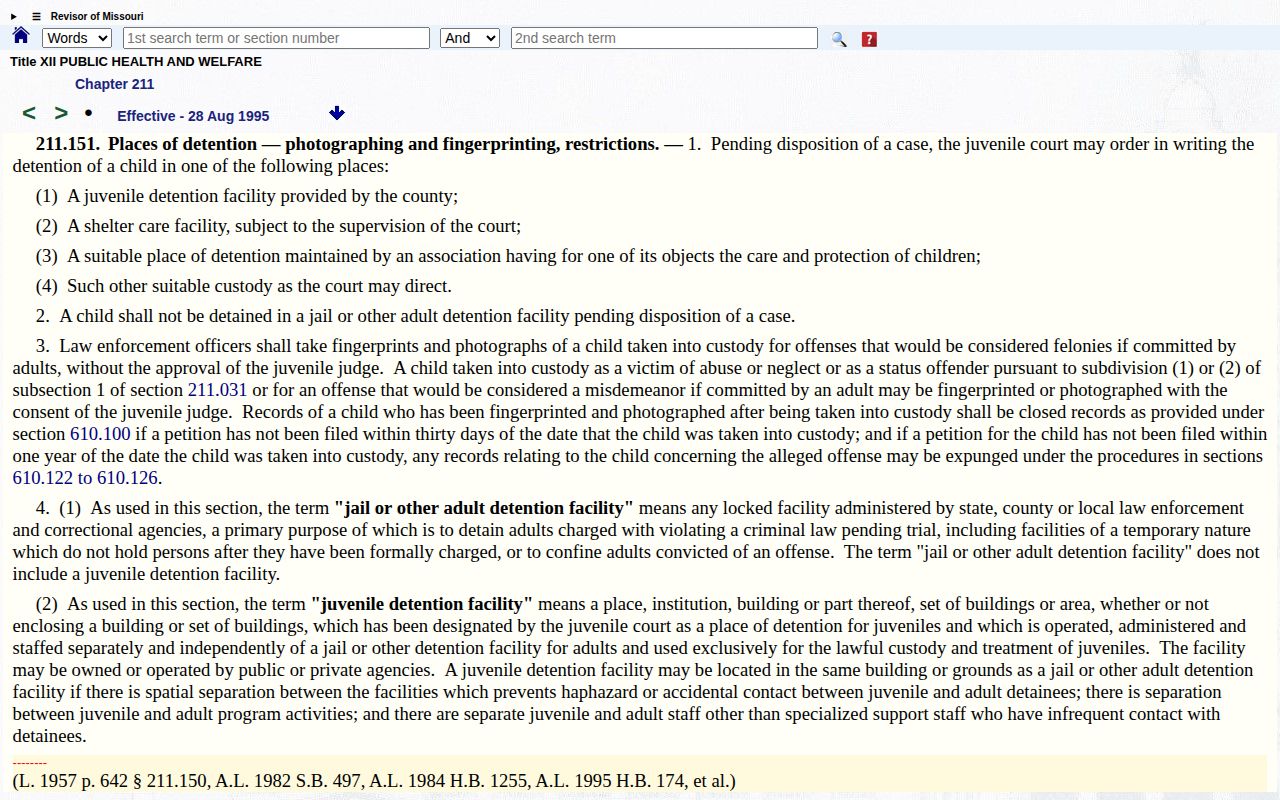
The statute supplies the legal setting for juvenile detention, not a roster. It reinforces why an adult release search cannot be copied onto the Stoddard juvenile facility.
Stoddard Juvenile Facility Contact
The official 2025 PREA audit identifies the facility and address. The research did not verify a public release-record phone line or public records-counter hours. Use the authorized contact listed in the juvenile case or official facility materials rather than guessing at a direct release line.
Stoddard County Regional Juvenile Detention Center100 S. Prairie St.
Bloomfield, MO 63825
Individual release inquiries: authorized juvenile court or facility channel
Public records hours: not verified
The Stoddard County Circuit Clerk can route public court questions at P.O. Box 30, Bloomfield, MO 63841, 573-568-4640, or stoddard.Shared.eMail@courts.mo.gov. The clerk may still be unable to disclose protected juvenile information. A routing contact does not create a right of access.
Stoddard Juvenile Facility Audit
The Missouri Department of Social Services publishes a 2025 Prison Rape Elimination Act audit for the Stoddard County Regional Juvenile Detention Center. That document is an operational oversight record. It helps verify the facility's identity, location, and juvenile role.
An audit differs sharply from an individual detention file. It addresses facility policies and compliance rather than naming children for public tracking. The official 2025 PREA audit gives institutional context, but it is not a way to confirm that a particular juvenile was detained or released.
This distinction matters when public facility documents appear in search results. A government PDF can be official and useful while still offering no authority to reveal a protected case.
No Stoddard Juvenile Lookup
The adult released-inmate process starts with a booking identity, release log, destination, Case.net record, and sometimes a state or federal locator. Copying that process here would erase the confidentiality rules that make juvenile custody different.
The Stoddard County Jail release page applies only to an adult county-jail event. It should not be used to infer that a juvenile is in adult custody. Likewise, the MODOC adult offender browser, BOP locator, MSHP arrest report, and sex-offender registry are not general juvenile release tools.
If an authorized party is unsure where a child was placed, the juvenile officer or court should trace the authorized placement chain. A blank public search result is not proof that the child was released, transferred, or never held.
No Stoddard Juvenile Release Feed
The research found no official public roster, 24-hour release list, 72-hour release list, archived booking search, or mobile application for the Stoddard juvenile center. Those missing products should not be treated as a gap that an unofficial site can fill. Publishing a child's name or movement without an authorized source could blur the legal protections that govern the juvenile proceeding.
Adult fallbacks also have the wrong scope. The Highway Patrol's five-day reports are preliminary adult-arrest signals and do not form a juvenile release ledger. MOVANS reports participating custody movements within its system, but a search miss cannot override juvenile confidentiality or confirm release. Case.net public name search may omit protected or confidential parties. MODOC's offender browser concerns active state corrections clients, not a general list of juveniles who left this regional center.
An authorized requester should work from the case, not from a broad feed. The case number, assigned court, juvenile officer, counsel, and current placement paperwork provide the sound starting points. Ask one precise question, such as whether a release instruction has taken effect or which authorized agency now has responsibility. Be prepared to verify identity and legal relationship.
A records office may confirm that information cannot be disclosed publicly. That response is not evidence of continued detention. It only defines the requester's access. The court or authorized case professional remains responsible for communicating a child's status to people entitled to receive it.
Stoddard Juvenile Record Types
Different records describe different parts of the juvenile process. Keeping them separate prevents an operational document from being mistaken for an open custody record.
- Facility audit
- A public oversight document about facility practices, not an individual roster.
- Juvenile case record
- A court-controlled file whose access may be confidential or limited.
- Placement record
- An agency record showing an authorized placement or transfer, subject to juvenile access rules.
- Release instruction
- A court or authorized agency direction governing when and where a juvenile leaves detention.
Only the responsible court or agency can say which document is available to a particular requester. Public research can identify the right institution and legal boundary, but it cannot supply individual juvenile custody details.
Stoddard Juvenile Placement Chain
A juvenile detention exit should be read as one event in a court-directed placement chain. The next step might involve a guardian, another authorized facility, a treatment placement, or another juvenile justice arrangement. The research does not identify which outcomes apply to any child, and no public page should guess.
Authorized readers should preserve the date and source of each direction. A court order explains legal authority. A facility movement record documents when the center acted. A receiving placement confirms where responsibility continued. These records may carry different dates without conflict because an order can precede the physical movement.
Public silence also has no single meaning. A record may be confidential, sealed, unavailable to that requester, or held in a system outside ordinary public search. The authorized case contact remains the proper source.